A project-based learning unit that ends on a professional stage
Meets all seven Gold Standard PBL criteria · Grades K–8
Opera Kids is a full-term project-based learning unit: one term, one real production — driving question, sustained inquiry, student voice and choice, critique and revision — presented to a public audience in a professional theater. Every material arrives prepared: workbook, teacher guide, lesson plans, rehearsal tracks and an in-person teacher masterclass, taught at your school. The vehicle is a real opera, sung by your students beside professional singers. We are opening the US pilot for the 2027–28 school year with a small founding cohort of schools.
What a term looks like
An in-person masterclass for your staff, then online support from our team for the rest of the project. Each teacher receives a certificate of completion recording the hours. No music degree required.
About ten weeks, inside your term. Working opera singers and musicians lead workshops in your classrooms — vocal technique, staging, expression — as students research and revise their own decisions.
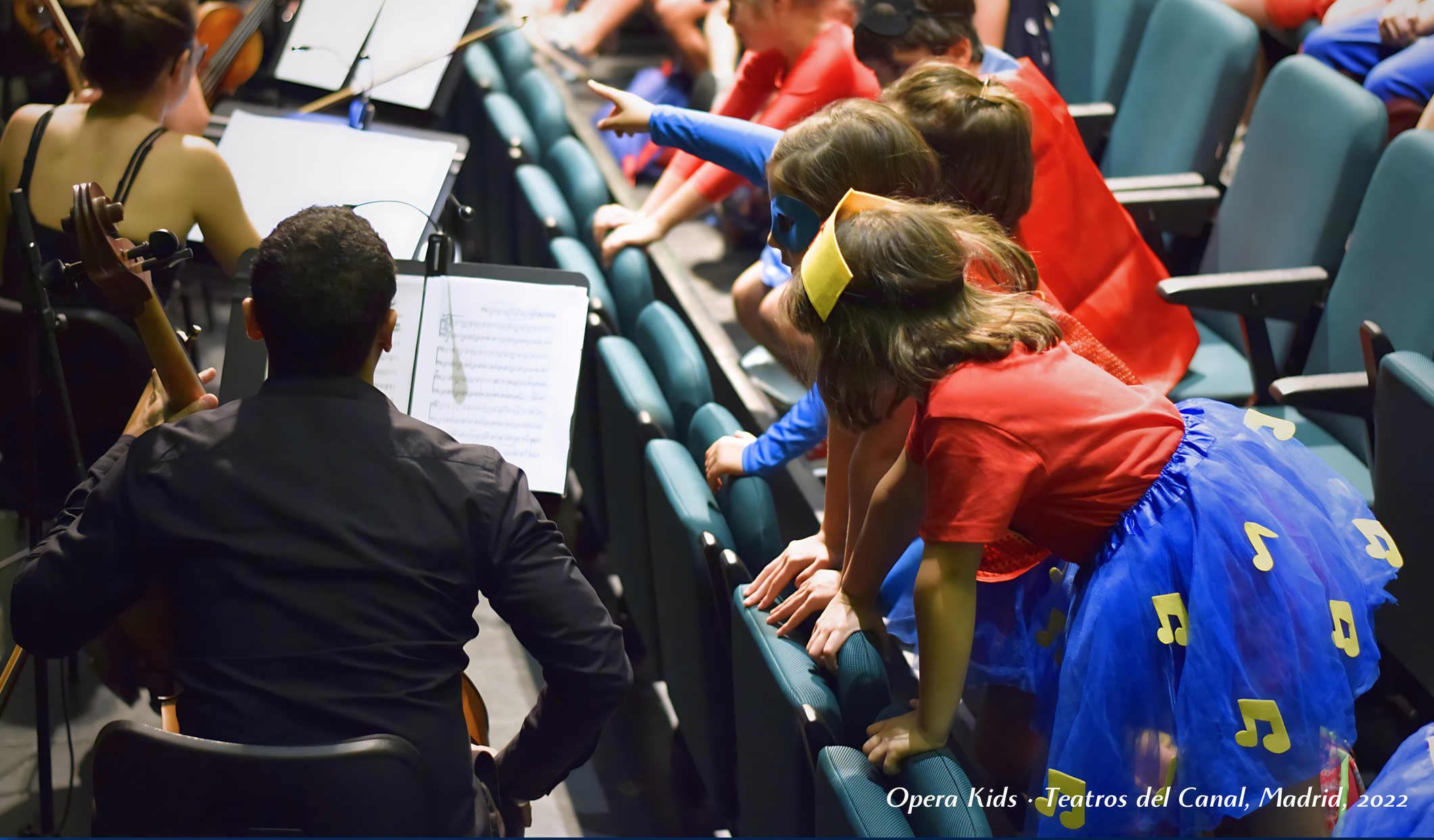
Students perform at a professional theater, beside professional singers. Families can attend the final performance on request.
A full standards crosswalk — codes at the grade-2, grade-5 and grade-8 anchors, plus the seven Gold Standard PBL criteria — is available for your accreditation self-study.
- Self-awareness
- Social awareness
- Relationship skills
- Responsible decision-making
- Multiple means of engagement
- Multiple means of representation
- Multiple means of action and expression
- Creating
- Performing
- Responding
- Connecting
- Speaking & Listening
- Reading
- Language
- Vocabulary
Named, practiced and assessed — never left to happen on its own. In most school productions emotional growth is a welcome side effect of putting on a show. Here it is what the sessions are built around, and it is worked every week.
How we do it
Emotional education is deliberate, not a side effect. Characters and scenes are used to name emotions and to recognize them in others, and each opera carries one social theme, worked through the workbook, guided discussion and cooperative activities.
Short self-assessment and peer-assessment moments close the work, so students judge their own progress rather than only receiving a verdict.
Designed in from the first draft, not adapted afterwards. The material is not a standard version plus adjustments: the options are in it from the start, so nobody receives a different one.
How we do it
Built in from the design stage. The material is made for different learning profiles and neurodivergences: the workbook is laid out visually, with pictograms and QR codes to extra material, the rehearsal tracks carry different levels of support, and selected fragments are recorded with sign-language interpretation, so deaf and hard-of-hearing students take part and the rest of the group meets signing.
The exercises come with alternatives rather than one prescribed way of doing them. Each vocal exercise is given as a set of options — the teacher picks the one that fits the group, or substitutes another adapted to it — and the workshop activities let every student take part through the body, the voice, the rhythm or the stage, adjusting instructions, timings and supports.
Collaboration, communication, creativity and critical thinking — practiced every week, not taught as a topic
How we do it
Critical thinking is asked for by name. Why does society cast Violetta out? Students analyze it and argue it, through the work rather than through a lesson about it.
Collaboration is structural: everyone sings everything, but each group carries its own character and has to watch the direction, so singing and moving together is the stated objective of the session, not a by-product of it.
A term of sung Spanish, with articulation and diction worked line by line. How much further it goes is your choice.
How we do it
The method has a technique for getting there: the text is first recited rhythmically, so the language and the rhythm arrive together, before the singing does. Articulation and diction are then worked line by line, and musical terms stay in Italian.
Optional, and you decide: spoken Spanish in the sessions, the workbook and materials in Spanish, or the whole unit delivered in Spanish. It works with none of them and it works with all of them.
Emergent bilinguals and heritage speakers take part on the same footing.
This is a project-based learning unit, not a dual-language programme, and we would rather say so than have you find out. It does not replace your language instruction. It gives that instruction a term of real use — a text your students have a reason to pronounce well, in front of an audience.
The story is the case study — choices, and the consequences that follow
How we do it
Each opera carries its own theme, taken from the plot rather than bolted onto it.
L’elisir d’amore — consumption, waste, and the difference between wanting and needing, through Dulcamara’s elixir.
Le nozze di Figaro — gender roles, through the disguises and the swapped parts.
La traviata — health, wellbeing, and why illness gets judged.
Worked from emotional safety and respect, at the depth the group can hold.
One term, one goal every child can see. Every task feeds the performance
How we do it
A term with one visible goal, and the work is staged toward it.
The last session before the performance runs explicitly as a general rehearsal: what was learned is consolidated, entrances and exits are rehearsed, and every student is told plainly that this is group work in which each one has a part. Nothing is discovered on the day.
Music, drama, visual arts, literacy and history taught through one work, with real objectives in each
How we do it
Making is part of the module. Students design and build costume and set pieces for their own opera — villagers and Dulcamara’s assistants for L’elisir d’amore, costumes after Goya for Le nozze di Figaro — with step-by-step video tutorials for the teacher, adaptable to the manual skill and the materials a classroom actually has.
Who wrote the opera, when, and what that world was like — children encounter a work of shared cultural heritage
How we do it
The story is told act by act, with who each character is and what they stand for, so students follow the work itself rather than a summary of it.
A video opens the professions of the opera house, and the questions afterward are real ones: which jobs did you see, what languages is opera sung in, where does the orchestra sit, which would you choose.
Every child stands in front of an audience carrying a part of their own
How we do it
The vocal work is technical, and every part of it is named. Body warm-up, then the three rules of breathing — shoulders still, no noise, fill like a balloon — and in for four, out for twelve. Vocalises the students learn by name.
Singing by imitation, phrase by phrase, isolating one word to place the upbeat and counting the pulses on a long note. Squats to feel the support under a high note.
Then a professional singer sings in the room — unamplified, a few feet away. The students hear what changes between low, middle and high, and they feel it: a trained voice carrying at that distance is physical, moving the air and the floor. No recording reproduces that. It only happens in person.
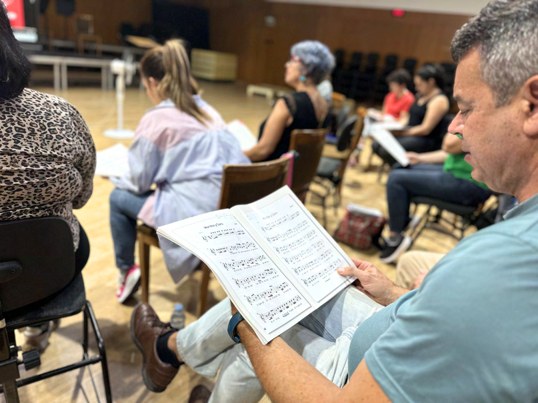
Teacher masterclass · Opera Kids Carmen Delivered at your school or a partner theater, then online support from our team for the rest of the project. Five parts:
- The method
- Vocal warm-up lab
- The opera, fragment by fragment
- The materials, hands-on
- Into your classroom
Running through all five: the opera house as the guiding thread · emotional education · adaptations for neurodivergent learners · the social theme of the opera.
Written for a teacher with no music degree: what to work on, what to listen for, and where each activity sits against the standards.
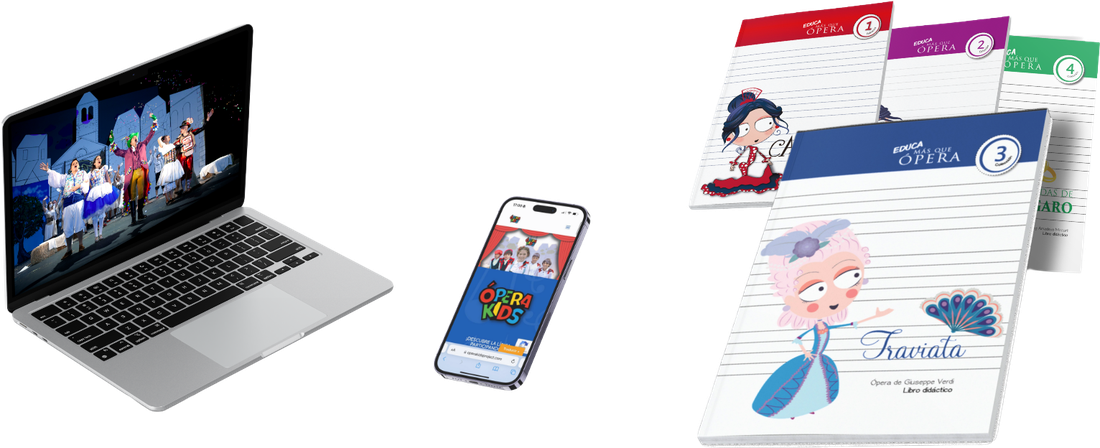
Carmen · US Standards Alignment, with codesEach activity against NCAS, Common Core ELA, C3, CASEL and WIDA ELD — full wording at the grade-5 anchor, with the K–2 and 6–8 equivalents beside it. Built on Nevada’s ELD adoption; we map it to your state on request.Open or download ↗The digital workbook is included for every student in the grade, in English or Spanish. Laid out visually with pictograms, so a student who struggles with dense text can follow it. Bianca, the mascot, runs through the year and comes back with each new opera.
Printed copies are optional and priced separately. Tell us how many you want and for which grades, and we quote it with the program — nothing about the unit depends on them.
Thirteen pages from the La Traviata workbook, English edition — every title comes in English. Click any page to see it full size.
Sample pages from the workbookA full title, cover to cover, so you can see the layout, the activities and how the language sits on the page.Open or download ↗The workbook is laid out visually, with pictograms and QR codes to extra material. The rehearsal tracks carry different levels of support. Selected fragments are recorded with sign-language interpretation, and every exercise arrives as a set of options your teacher chooses from.
The order and the number of sessions, laid out for your grade levels and the format you choose. Your teacher opens it and teaches.
Tell us what you need to know about this and we will send it.
Email us about this →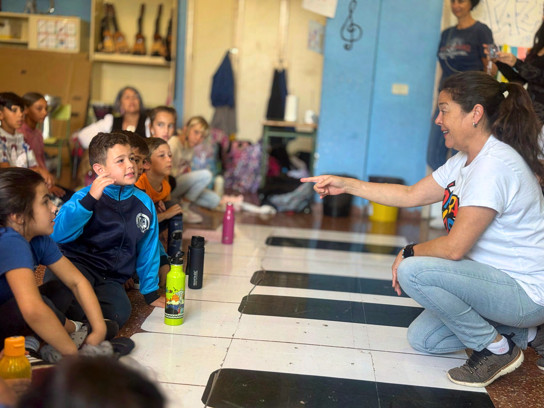
A classroom workshop · Colegio Oasis de Maspalomas - Working opera singers and musicians, trained in the method, in your classrooms — voice, staging, expression.
- At least two 60-minute workshops, on two different days, in school hours. More can be added.
- Some of them sing in the production your students perform in: not a separate team.
- Your teacher leads the class; the singer works with them, not instead of them.
- Same sequence in every school, adapted to each group — that is what makes the groups fit together on the day.
- Built visually: projections, sound and movement; the text is recited rhythmically before it is sung.
- After the performance, a follow-up workshop at school closes the loop.
Before the show, families can be offered a workshop where they try the method themselves — the same exercises their children have been doing all term. Families leave knowing what their child has been working on, and able to do a little of it at home.
Optional, arranged with the school and priced separately. Nothing in the unit depends on it.
A certificate of completion for each teacher, naming the training and the hours. Whether those hours count toward salary advancement is your district’s decision, not ours — most California districts require units from an accredited university. Tell us what your district’s form asks for and we will tell you straight what we can provide today.
Every activity, plus tutorials — how to make the costumes, and more. Teachers and students log in separately, and each sees their own materials.
The best way to learn music — by making music. You just have to give children the chance to discover it.
It really is a before and after for them — it opens up a new world.
Who works with you
Opera Kids was written by three working opera professionals, not by a publisher. Amanecer Sierra, who directs the project, and Ariadna Martínez, who wrote the books and the musical adaptations, teach in the classroom workshops themselves. Aquiles Machado directs what happens on stage and works with your teachers. The three of them train the teaching artists who run the workshops in your classrooms, so the method is delivered to our own standard, in every school.
Tenor with three decades of international career and winner of the Operalia competition. He has sung leading roles at the Metropolitan Opera in New York, La Scala in Milan, the Vienna State Opera, the Bavarian State Opera, the Paris National Opera, the Bolshoi, the Teatro Real and the Liceu. Trained with Alfredo Kraus at the Reina Sofía School.
Today he is artistic director of one of the oldest opera seasons in Spain, in A Coruña. Doctor Honoris Causa, and deeply committed to music education for children: he has led El Sistema in Venezuela, where he directs its vocal department.
Soprano and audiovisual producer. Graduated in Film and Broadcast Production from London Guildhall University, studied the Triennio in Canto at the Santa Cecilia Conservatory in Rome, trained in acting at Playhouse West in Los Angeles, and studied vocal technique with Seth Riggs, creator of Speech Level Singing.
She worked in film production and visual effects in London and New York, and spent two years with Scuole all’Opera, the education program of the Rome Opera that inspired Opera Kids.
She has sung Turandot, Mimì, Amelia, Santuzza and Luisa Fernanda, covered Tosca at the Puccini Festival in Torre del Lago, and was soloist in Verdi’s Requiem at the Auditorio Nacional with the Orfeón Donostiarra. She directs the project and teaches in the workshops herself.
Living with ADHD and dyslexia herself, she works for an education that is more inclusive and more aware of neurodivergence — in the classroom and on the stage. Opera Kids comes in part from that: a method every child can adapt to the way they learn and enjoy it, without embarrassment.
Soprano, educator, pianist and choir director. Specialist music teacher from the University of the Basque Country, with advanced studies in Voice and Music Pedagogy at the Navarre Conservatory and further training at ESMUC. Member of the National Choir of Spain.
She has sung at the National Centre for the Performing Arts in Beijing, the Auditorio Nacional in Madrid and the Euskalduna in Bilbao, in roles including Musetta, Micaëla, Adina, Susanna and Liù. She is the author of the musical adaptation and of the books of the Opera Kids method.
All content, images and designs are original works created for the Opera Kids® Method.
CALENDAR: a one-term in-school residency — about ten weeks that sit around your timetable, with two fixed dates · BUDGET: project and PD budgets · AFTER THE FIRST YEAR: a new opera each year, over a six-year cycle
Calendar — One term, one opera. Two dates are fixed: the teacher masterclass, which has to happen at least three months before the show, and the performance itself. Between them, about ten weeks of classroom work that sit around your existing timetable — nothing is added to the school day.
Budget — Project and PD budgets.
Year on year — Schools that continue take a new opera each year, over a six-year cycle, with skills returning at greater depth. You can join in any year.
Pilot year — For the founding cohort, calendar, budget and format are agreed with your school rather than fixed in advance. We build the term around the year you already have.
Compliance. Background checks, fingerprinting and a content advisory with a parent opt-out form will all be in place before the first class.
Más que Ópera · Asociación Cultural · operakidsproject.com